Illumio Outgrew HubSpot. Time for the Mature Stack.
HubSpot is the bundle most B2B marketing teams start on. CMS, marketing automation, lead capture, and basic analytics in a single subscription a small team can run without an engineer. It does that job at the scale it was built for.
Growth-stage companies pass that scale. HubSpot's pricing scales with contact-database size, marketing-hub tier, traffic volume, and seat count — costs that compound faster than the platform's value to a marketing team that's added engineers, taken on multilingual ambitions, integrated Marketo or Salesforce, and started running its own demand-generation operation. The flexibility ceiling that keeps HubSpot's UX simple for small teams becomes a hard wall for teams that need custom content models, complex product taxonomy, integration depth, or enterprise-grade performance and compliance posture. The right answer at \$5M ARR is often the wrong answer at \$50M. The right answer at \$50M is a more mature stack — a flexible CMS at the content layer, a dedicated marketing automation platform at the automation layer, and a CRM at the relationship layer, tied together with custom integration. For Illumio, that landed on Drupal, Marketo, and Salesforce. For other growth-stage companies the components vary; the architectural shape doesn't.
Illumio's website on HubSpot served the company well through early growth. By late 2019, the business had grown past what the bundle was built for.
Three reasons it was time. Cost. HubSpot's pricing scaled with Illumio's contact database, traffic, and feature surface — costs that grew faster than the platform's value to a marketing team that needed an enterprise architecture, not a small-business one. Flexibility. HubSpot's content model, designed for SMB marketing teams who don't need much customization, wasn't built for a growth-stage cybersecurity company with multilingual ambitions, complex product taxonomy, and an integration backlog with Marketo and Salesforce that HubSpot's bundled tools couldn't accommodate. The deadline. The HubSpot contract was expiring. Either the new platform was live before the renewal date or Illumio was paying for extra months no one wanted to pay for.
Igility had 60 days from the date the SOW was signed. The conversion of an existing custom HubSpot codebase, a years-old content corpus, and an integration backlog with Marketo (then in parallel implementation) and Salesforce — all into Drupal — fit inside that window or it didn't fit at all.
55 Days From HubSpot to Drupal — Three Decisions That Made the Timeline Hold
Three architectural decisions made the timeline work.
Component-mapped Drupal paragraphs. The component library on the HubSpot side — heroes, card grids, alternating-row sections, segmentation comparison matrices, news sections, gated-content forms — got mapped one-to-one to Drupal paragraph entities. The HTML and CSS Illumio's design team had built carried over directly. Custom JavaScript ported across with structural revision but no rewrite. The visual brand stayed identical at launch. The content authoring experience aligned with what the marketing team already knew. This mapping decision was made before any code was written, and it's the decision that let the rest of the timeline hold.
Scripted content migration. Every other approach — copy-paste, manual page rebuilds, "freeze content during migration" — would have stranded Illumio's content team mid-migration with no way to publish for weeks. The scripted approach migrated the full HubSpot content corpus on a schedule the marketing team could see, including pages edited the day of cutover. When the new site went live, the latest content was already on it. No re-keying, no missing posts, no broken links.
Acquia Cloud + Acquia Search + Marketo + Salesforce + Cludo. The hosting environment was Acquia's enterprise Drupal cloud. Apache Solr through Acquia Search powered the resource center's faceted browse. Cludo (Illumio's existing site search) integrated through Drupal's modular system so the search experience felt continuous across the cutover. The Drupal forms layer fed Marketo for lead capture and Salesforce for CRM through a custom integration Igility built — gated content, contact forms, register-to-watch flows, all captured durably in Drupal first, then posted downstream, so a Marketo or Salesforce hiccup never lost a lead.
The migration ran across four milestones — template plus system configuration, two development sprints, testing plus launch — and finished inside the 60-day window. The HubSpot contract expired without a renewal payment.
Year One: +124% Traffic, +290% Opportunities, +70% Pipeline Impact
A platform that opens with a 55-day technical sprint isn't remembered for the technical sprint. It's remembered for what the marketing team produced on top of it.
In the first year after launch, Illumio's site delivered measurable improvement on every metric the marketing team tracked, against the prior-year HubSpot baseline:
- +124% traffic — top-of-funnel growth on the same brand and product portfolio, on the new platform's improved performance and SEO posture
- +37% site conversions — visitors who arrived turned into qualified actions at a meaningfully higher rate
- +52% MQLs (Marketing Qualified Leads) — Marketo's scoring layer flagged better leads coming through the Drupal forms than HubSpot had been producing
- +290% opportunities — the lift from MQL to opportunity was the cleanest signal that the platform wasn't just generating volume; it was generating intent
- +70% web impact on Marketing Sourced Qualified Pipeline — at the dollar-weighted attribution layer (the measure CFOs ask about), the website's contribution to the marketing-sourced pipeline grew over two-thirds
- 480+ hours saved annually — the new self-serve content tools meant Illumio's marketing team stopped filing developer tickets for routine content updates
- 50%+ reduction in web production time for go-to-market initiatives, product launches, and campaigns
These numbers came from Illumio's Marketo plus Salesforce attribution stack and were the basis of Igility's 2020 Acquia Engage Awards submission in the Best Return on Investment and Quickest to Launch categories.
The +290% opportunities lift is the metric a CMO uses when justifying the platform investment to the CFO. The +70% pipeline-impact figure is the one the CFO uses when approving the next year's marketing budget.
Embedded for Three Years — Core Web Vitals From Day One, Then Localization, Then Product Launches
The 55-day migration was the audition. The work that followed was the engagement.
Core Web Vitals optimization from day one of Google's rollout. Google announced Core Web Vitals as a search-ranking signal in May 2020 with the rollout completing through 2021. Igility began Illumio's CWV work in December 2020 and ran it through August 2021 — Illumio was tuning for the new performance criteria from the moment they were public, not catching up after they affected rankings. Largest Contentful Paint, First Input Delay, Cumulative Layout Shift — all addressed through SCSS rebuilds replacing the migrated CSS, Responsive Image Styles, Critical CSS extraction, lazy loading for below-the-fold media, and the structural refactoring CWV demands. Illumio entered the post-rollout era with a site already at the targets that most B2B platforms spent 2021 chasing.
Multilingual rollout — Japanese in three days, then German. Illumio's international expansion required multilingual content. Igility integrated Translations.com's GlobalLink translation platform directly into the Drupal content workflow. The Japanese proof-of-concept site launched in less than three days post-integration. German followed in March 2022. The marketing team shipped multilingual content without managing the translation operation manually — GlobalLink handled the translator workflow, Drupal's multilingual content model handled the structural rendering, and the same component library that worked at the original launch worked across every locale.
Marketo plus Salesforce integration. Custom-built, replacing HubSpot's bundled marketing automation. Marketo handled lead scoring and nurture; Salesforce handled CRM. The Drupal forms layer fed both, with durable-first capture so a downstream issue never cost a lead. Lead-routing logic carried over to Marketo's nurture flows; conversion data carried back into Drupal for content-performance reporting.
Product launches. Multiple product launches across the engagement period, each supported by site updates, campaign assets, integrated lead-capture, and the operational coordination a launch demands. Some launches required new microsites; some extended the main site; all moved through the same embedded model.
Conferences, training, design, marketing automation. All ran through the same engagement structure. Sprint cadence at two weeks. Continuous prioritization. No project-by-project re-onboarding.
What "Embedded Agency" Means Inside a Blitzscaling Company
Reid Hoffman, the LinkedIn founder, named the discipline of blitzscaling — prioritizing speed over efficiency in companies facing winner-take-most market opportunities. Cybersecurity is one of those markets. Illumio is one of those companies. The standard agency model — discrete projects with multi-week kickoff cycles, fixed-bid scopes, change orders for every adjustment, account-management layers translating between client and developer — is structurally incompatible with that operating tempo.
What Igility built with Illumio was a different model.
A team that flexes against the company's tempo. The original Drupal migration ran with one shape of team. A major June 2020 product launch ran with an expanded team operating against a 285-hour budget addendum approved within days of the scope shift. The Core Web Vitals work ran with a different sub-team. Localization added more. The shape of the team adjusted to the work, not the other way around.
Embedded PM, not detached project management. Igility led project management on what to do and when. The model wasn't "give us a brief and we deliver an estimate"; the model was "we surface the dependencies, propose the sequencing, and educate the marketing team on the trade-offs." Illumio's web leadership at the time described the relationship as a seat at the table with unique expertise.
Education as part of the contract. Marketing leaders unfamiliar with Drupal's content architecture, with Core Web Vitals' technical requirements, with multilingual content workflow, needed to understand why some changes took longer than others, why CWV optimization wasn't a quick fix, why localization needed an integration layer rather than a content drop. Igility took on that education work as part of the engagement, not as a billable add-on.
Direct communication. Slack and Zoom between Illumio's marketing team and Igility's developers and project leads, no account managers translating in the middle. Two-week sprint reviews against a shared backlog. Decisions made in the call, not three days later in a follow-up email.
The other unusual part of the model: spanning the full martech stack. Most agencies specialize at one layer — content for CMS shops, automation for Marketo partners, sales-ops for Salesforce shops. Igility carried Illumio across all of them, including the inbound-from-HubSpot conversion at the start. HubSpot → Drupal → Marketo → Salesforce under one engagement is rare. At a blitzscaling company's tempo it's also necessary, because the work crosses layers daily — the team that built the CMS components was the same team that wrote the Marketo automation logic and tuned the Salesforce integration. Hand-offs between layer-specialist agencies introduce the kind of friction the embedded model exists to remove.
This is what Igility's prior case study summary described as "an extension of Illumio's team." That phrase undersells what the model actually does. Standard agency engagements rebuild trust at every project boundary. Embedded engagements compound it.
What Comes Next for Cybersecurity Marketing Platforms
B2B cybersecurity buyers are doing the same thing every other B2B buyer is doing — using AI tools during procurement research. Seventy-three percent of B2B buyers now use AI tools during purchase research, and 51% of B2B software buyers start that research inside an AI chatbot. Cybersecurity buyers are moving the same direction; security architecture decisions are increasingly informed by AI-assisted research before any vendor call happens.
The platforms AI systems can find, parse, and cite are the ones with structured product taxonomy, consistent terminology, schema markup, and content authored at the technical depth a security architect actually needs. The Illumio platform was built with those foundations because that's what enterprise B2B cybersecurity buyers needed in 2020 — the same structural choices now position any cybersecurity brand to be discoverable inside ChatGPT, Perplexity, Gemini, and Google AI Overviews.
That's the discipline Igility now calls Answer Engine Optimization (AEO). The architectural decisions that compounded for Illumio across three years compound the same way across Mobile Mini's nine-year B2B platform, Helmer Scientific's eight-year medical-device platform, and the AEO layer Igility now builds on top of platforms like them. For the methodology, see the B2B AEO guide. For where your own platform sits across Google and eight AI engines — the same diagnostic Igility ran on Illumio in 2020 in a different form — start with the free AI visibility audit.
Frequently Asked Questions
When does a company outgrow HubSpot, and what replaces it?
The inflection point usually shows up at three boundaries simultaneously. Cost — HubSpot's seat-count, contact-database, and tier pricing starts costing more annually than a comparable mature stack would cost to build and operate, and the price escalates faster than the platform's value to the marketing team. Flexibility — the marketing team needs custom content models, complex product taxonomy, multilingual content workflows, or integration depth that HubSpot's bundled tools can't accommodate, and the workarounds (HubDB, custom HubL, embedded scripts) start fighting the platform rather than extending it. Operational maturity — the marketing organization has added engineering capacity and a dedicated marketing-operations function, and the bundled simplicity that originally protected the team's velocity now constrains it. None of these is a reason to leave HubSpot in isolation. All three together are. Illumio's engagement with HubSpot crossed all three boundaries roughly simultaneously in 2019. What replaces HubSpot is the same set of capabilities separated into specialized layers — a flexible CMS at the content layer (Drupal in Illumio's case; WordPress with custom theming, headless CMS options like Sanity or Contentful, or modern frameworks for others), a dedicated marketing automation platform (Marketo, Pardot, or Salesforce Marketing Cloud), and a CRM (Salesforce, Microsoft Dynamics, or HubSpot CRM standalone), tied together with custom integration. The architectural shape is consistent across migrations; the components vary by team.
How do you migrate from HubSpot to Drupal in 55 days?
Three decisions. Build the component library as Drupal paragraph entities mapped one-to-one to the HubSpot components you're replacing — preserve the existing HTML, CSS, and design language rather than rebuilding the visual brand under deadline pressure. Script the content migration so the cutover preserves edits made the day of launch. Wire the durable-first integration layer (forms capture in Drupal, then post to Marketo and Salesforce) before launch, not after. Skip any of the three and the timeline doesn't hold. The architecture decision is the rate limiter, not the engineering volume.
What's the difference between an embedded agency engagement and a standard agency engagement?
A standard agency engagement runs project-by-project, with kickoff cycles, fixed-bid scopes, change-order processes for every adjustment, and account-management layers between client and developer. An embedded engagement runs at sprint cadence against a continuously-prioritized backlog, with the agency leading PM, education, and architecture decisions while the client team retains strategic direction. Embedded engagements work for clients with continuous build needs at faster-than-quarterly tempo — typically blitzscaling companies, growth-stage SaaS, M&A integrations, and complex multilingual operations. They don't work for clients who need a one-shot project with a clear handoff. For an evaluation framework, see Igility's platform-migration service overview.
How does Drupal handle multilingual content with Translations.com GlobalLink?
GlobalLink integrates directly into Drupal's multilingual content model. Marketing teams author content in the source language, then trigger translation workflows that route the content to Translations.com's translator network, return the translated copy to Drupal, and render it through the same component library that produced the source-language version. The integration is bidirectional and content-element-level, so a single page edit in English produces a tracked translation request without manual export-and-import. Illumio's Japanese proof-of-concept site launched in less than three days post-integration; German followed seven months later.
What does Core Web Vitals optimization actually require?
Three measurable targets: Largest Contentful Paint under 2.5 seconds, First Input Delay under 100 milliseconds, and Cumulative Layout Shift under 0.1. Hitting them requires structural work, not configuration changes — image optimization through Responsive Image Styles, Critical CSS extraction for above-the-fold rendering, lazy loading for below-the-fold media, JavaScript deferral for non-essential scripts, font-loading discipline, and SCSS rebuilds replacing migrated legacy CSS that often carries unused selectors. Sites tuned to CWV from before the rollout entered the post-rollout era already at the targets. Sites that started after the rollout spent months catching up.
Why does an emergency CMS migration cost about the same as a planned one?
In absolute terms, it usually does — the architecture and engineering work for a migration is roughly the same whether the deadline is 60 days or six months. What changes is the team shape needed to hit the deadline. A six-month migration runs with a smaller team for longer; a 60-day migration runs with a larger team for less time. An agency that can't flex the team to the deadline either misses the deadline or quotes the calmer timeline. The question to ask any agency on an emergency CMS migration isn't "can you finish in 60 days" — it's "how does your team scale up to hit a 60-day target without the timeline becoming the budget."
References
Engagement Period
- Igility–Illumio engagement: February 2020 through Q1 2023. Drupal Migration SOW signed 19 February 2020; project start 4 March 2020; launch 1 May 2020. Engagement formally wrapped Q1 2023.
Client Attestation
- Sue Auchincloss (2023, June 21). Email to Brad Gronek, subject "Re: Igility - New Home Page + Testimonial Quote." Director of Global Web Services, Illumio (subsequently moved to Pure Storage; attribution retained at Illumio per Sue's approved wording, where the work happened). Sue edited Igility's draft testimonial and returned the canonical wording with the note "Pls use this version." Permission to use granted explicitly in that email; retained in Igility's testimonials record.
Authoritative Metrics Source
- Igility Solutions (2020). 2020 Acquia Engage Awards submission, Best Return on Investment and Quickest to Launch categories. Internal archive. Submitted 22 September 2020. Authoritative source for the year-1 metrics: +124% traffic, +37% site conversions, +52% MQLs, +290% opportunities, +70% web impact on Marketing Sourced Qualified Pipeline, 480+ hours saved annually, 50%+ web production time reduction.
- Igility Solutions (2024). Internal Illumio case study draft, authored following interview series with Sue Auchincloss conducted January through March 2023. Cross-confirms the year-1 metrics.
Hero Image Provenance
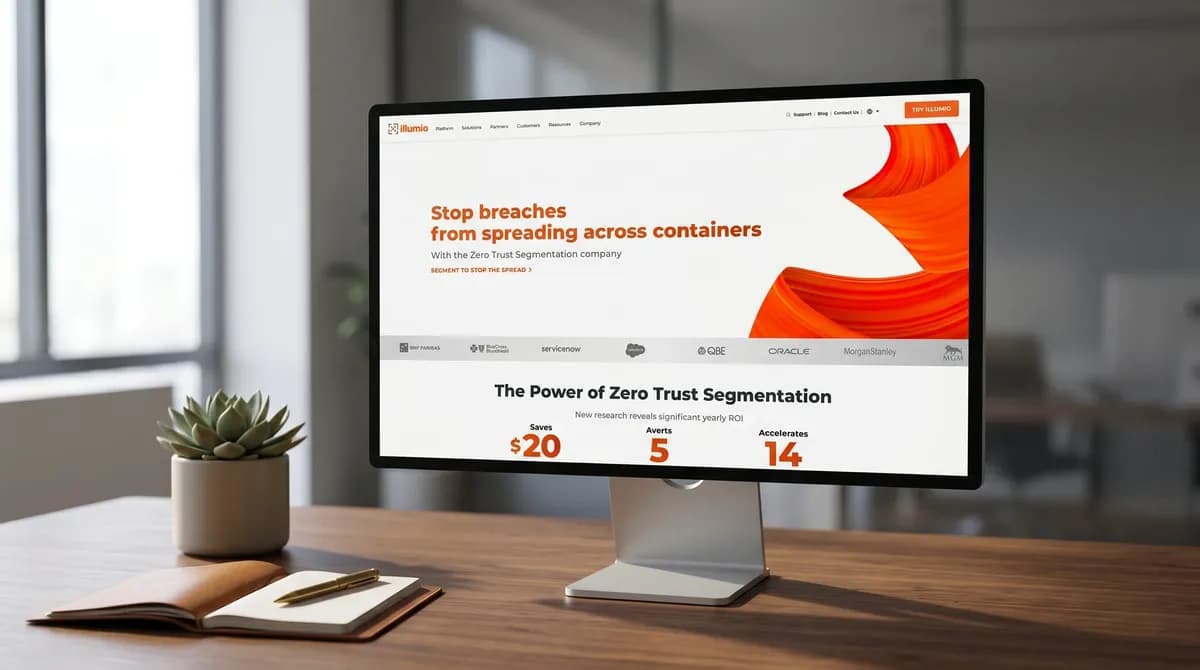
- Internet Archive Wayback Machine. The hero image is an editorial composite: the on-screen content is a faithful rendering of
illumio.com captured from the Internet Archive during the Igility stewardship period (2020–2023), showing the Drupal platform Igility built. The surrounding desk-and-monitor scene (walnut desk, Apple-Studio-Display-style monitor, soft window light, shallow depth-of-field office context) is generated to match Igility's editorial industrial-design case-study aesthetic. The "Stop breaches from spreading across containers" Zero Trust Segmentation hero, customer logo bar, and "Power of Zero Trust Segmentation" research callouts visible on screen were all rendered through the Drupal + Acquia Cloud architecture documented in this case study. The Wayback source capture is preserved alongside the published hero in the case study working directory (illumio-hero-source-wayback.{png,webp}) for provenance.
Architecture References
Methodology
- Reid Hoffman & Chris Yeh (2016). "Blitzscaling: The Lightning-Fast Path to Building Massively Valuable Companies." Harvard Business Review. The growth-stage operating model the Illumio engagement was structured to match.
- Google (2020). "Evaluating page experience for a better web." Google Search Central blog. Sets the timeline anchor for Illumio's "from day one of Google's rollout" Core Web Vitals work.
B2B Buyer AI Adoption (current-era context)
- Averi (2026). "73% of B2B Buyers Use AI Tools in Purchase Research, Multi-Source Analysis Finds." Yahoo Finance / PR Newswire. Analysis of 680 million citations, March 2026.
- G2 Research (2026). "Half of B2B Software Buyers Now Start Their Research With AI Chatbots." PR Newswire. 51% start with AI chatbot, up from 29% eleven months prior.