
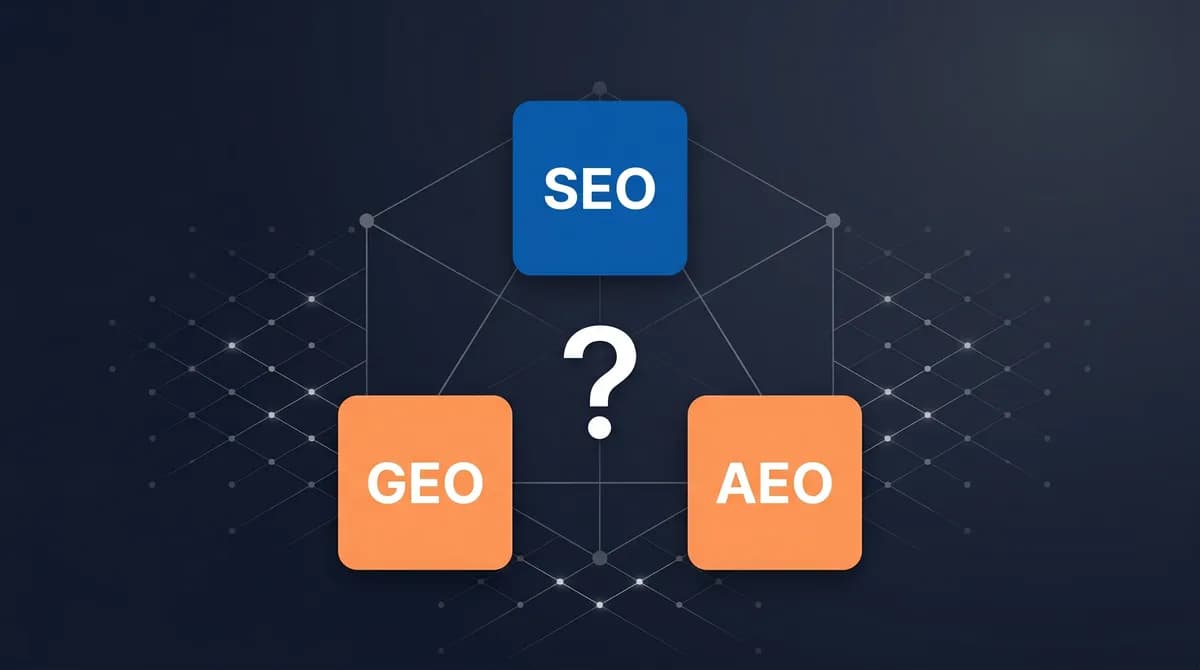
Search "aeo vs geo" on Google. The top ten results return three different answers. Three say AEO and GEO describe the same discipline. Three argue one's a subset of the other. Two split hairs about which term is more correct. One redefines GEO entirely as "Generative Experience Optimization." One is a Reddit thread where the community is still fighting about it. The AI Overview at the top synthesizes the mush into a confident-sounding paragraph that's wrong about the practitioner reality.
The question your CEO will ask in the next budget meeting isn't "what's the difference?" It's "are we behind, and is this on top of our SEO budget or instead of it?"
In brief: AEO and GEO describe the same discipline — structuring content so AI platforms cite your brand in their answers. SEO is the foundation both sit on. The 2026 question isn't which to pick, but how to split investment between the SEO ranking layer and the AEO/GEO citation layer.
The Three-Acronym Map (and Why People Are Confused)
The acronym soup describes two distinct disciplines, not three.
SEO — Search Engine Optimization. The discipline of ranking pages in a list of search results. Outcome: a position in the blue links. Engine: Google primarily, with a smaller Bing share.
AEO and GEO — Answer Engine Optimization and Generative Engine Optimization. Same discipline. The work of structuring content so AI systems — ChatGPT, Perplexity, Gemini, Claude, Microsoft Copilot, Google AI Overviews, Grok, Meta AI — cite your brand inside an answer. Outcome: a citation in an AI response. Engines: eight platforms, each with its own retrieval chain.
GEO is the academic term. It was coined in a 2024 ACM SIGKDD paper by researchers at Princeton, IIT Delhi, and the Allen Institute for AI, who also ran the controlled experiment showing that adding specific statistics and expert quotations boosted AI citation rates by up to 40%. AEO is the practitioner term that emerged in B2B agency and operations work after the paper. Profound takes the position that AEO is the clearer term. Contentful flatly states "GEO is also known as answer engine optimization (AEO)." Wikipedia cites the academic paper as the origin. The label is contested. The work is not.
A few other acronyms float around the same idea. AIO — sometimes "AI Optimization" or "Artificial Intelligence Optimization." LLMO — Large Language Model Optimization, used by Neil Patel and a small cohort. AI SEO — informal umbrella. All four describe the same work as AEO and GEO. Pick the term your buyers and analysts already use.
That collapses the problem to two disciplines: SEO and AEO/GEO. The rest of this piece compares those two and walks through how to split investment between them.
The Comparison Matrix: SEO vs AEO/GEO
| SEO | AEO + GEO | |
|---|---|---|
| Outcome | Position in a list of results | Citation inside an AI-generated answer |
| Primary engine | Google (with smaller Bing share) | Eight AI platforms — ChatGPT, Perplexity, Gemini, Claude, Copilot, Google AI Overviews, Grok, Meta AI |
| Retrieval mechanic | Crawl → index → rank against the query | LLM retrieval chain — fanout queries against an index (often Bing), training data, real-time crawl |
| Foundational signal | Links, content quality, technical health, schema | Structured data, extractable statements, Bing-side rankings, off-site authority signals |
| What "winning" looks like | Page-one positions, rising organic traffic, featured snippets | Brand named inside answers, source links to your domain, citation share against competitors |
| Time-to-first-signal | 3-6 months for new content; longer for competitive terms | 30-90 days for first AI citations after structural fixes |
| Measurement instrument | Google Search Console, rank trackers, GA4 | Multi-platform AI visibility audits, citation trackers (Profound, Sitefire, Geneo), brand-mention monitoring |
| Where the work lives | Site content, technical SEO, link earning | Structured data, citation-ready content, multi-platform tracking, Bing-side optimization |
| Skills required | Content, technical SEO, link earning, analytics | The above + structured data fluency + multi-platform measurement + Bing-specific work |
| Relationship to the other | Foundation — strong SEO drives AEO/GEO outcomes | Layer — sits on top of SEO foundations, doesn't replace them |
Four rows in the matrix carry most of the practical weight.
Outcome: rank vs cite. A #1 Google ranking and a ChatGPT citation are different outcomes. The same content can earn one without the other. A page can sit in position 1 for its target keyword and never appear in a single AI answer; another page can be cited in ChatGPT, Perplexity, and Copilot every week without breaking the top 20 on Google.
Primary engine: 1 vs 8. Google is one retrieval system. AEO/GEO spans eight, and each weights different signals. ChatGPT pulls from Bing's index via fanout queries — Bing's top results align with ChatGPT's brand recommendations 87% of the time, per Seer Interactive's controlled study. Perplexity has its own crawler. Gemini reads Google plus the Knowledge Graph. Claude leans on training data plus selective web access. Copilot reads Bing. A page that ChatGPT cites can be invisible to Perplexity, or the reverse.
Foundational signal: links vs structured data + Bing. SEO's primary signal is link authority, with content and technical health as the supporting structure. AEO/GEO's primary signal is whether the content is extractable — short citation-ready statements, FAQ-formatted Q&A, JSON-LD schema, entity definitions. Pages with schema markup are 36% more likely to appear in AI summaries and earn 2.8x higher citation rates, per xseek.io. In March 2025, both Google and Microsoft officially confirmed that their AI systems use schema during response generation.
Time-to-first-signal: 3-6 months vs 30-90 days. SEO is the slower compounding curve. AEO/GEO produces measurable citation gains faster because the structural fixes (schema, In-brief blocks, Bing verification) are mechanical and the retrieval chains pick them up within weeks. SEO wins long-run on persistence; AEO/GEO wins early on responsiveness.
The rest of the matrix is implementation context. Use it as the spine of a follow-up meeting, not as a list of things to memorize.
AEO vs GEO: Same Work, Different Origin
GEO and AEO describe the same discipline. The terminology split traces back to where each term was coined and which community adopted it.
GEO is the academic / research-originated term. Aggarwal, Murahari, Rajpurohit, Kalyan, Narasimhan, and Deshpande introduced it in the 2024 ACM SIGKDD paper — Princeton, IIT Delhi, and the Allen Institute for AI. Wikipedia uses it. Search engine vendors and analyst firms tend to prefer it because it tracks the peer-reviewed literature.
AEO is the practitioner / operational term. B2B marketers, agencies, and the people running audits, shipping schema, and tracking citations call it AEO. The keyword data is the cleanest evidence: searches for "AEO agency" come from people hiring agencies; searches for "answer engine optimization" come from people doing the work; searches for "generative engine optimization" come mostly from people writing think pieces about the category.
Both terms describe the same mechanics. The same structured data. The same eight platforms. The same Bing-fanout retrieval mechanic. The same Aggarwal et al. 40% finding about extractable statements. If you've already committed to an AEO strategy, you've committed to a GEO strategy.
Two related acronyms appear in the People Also Ask data and earn a one-line dispatch. AIO ("AI Optimization") and LLMO ("Large Language Model Optimization") describe the same citation work. Treat them as alternative labels.
AEO Strategy Audit, $45K. Three weeks later, a follow-on SOW from the same firm: GEO Optimization Roadmap, $35K. Q2 deliverable: AIO Implementation Sprint, $25K. Quarterly retainer thereafter: LLMO Maintenance, $8K a month. Four engagements. Same checklist of structured data, schema markup, and Bing verification. Congratulations. You're paying four agencies — or one agency four times — to ship the same audit and the same fixes against four different invoice line items. This isn't a coincidence. "AEO agency" searches grew 414% year over year and "AEO audit" grew 1,300% per DataForSEO, April 2026 — when category demand multiplies that fast inside twelve months, vendors fragment one engagement into four invoices because the labels are the part that's easy to multiply.
The practical rule survives the cynicism: pick the term your buyers, analysts, and CEO already use, then move on. Don't pay four agencies for one audit. (Igility's SEO/AEO methodology bills against deliverables, not against acronyms — same checklist of structured data, schema markup, off-site corroboration, and Bing verification regardless of what you call it.)
Why GEO Isn't Replacing SEO (and How They Compound)
The People Also Ask data surfaces the question on every CEO's mind: Is GEO replacing SEO? No. GEO is a layer on the SEO foundation, not a substitute for it. Three named compounding mechanics make the relationship structural rather than competitive.
Bing-side rankings drive ChatGPT citations. Seer Interactive's 87% finding — ChatGPT recommendations align with Bing's top results in 87 of 100 cases — means that strong Bing-side SEO directly produces AEO/GEO outcomes. ChatGPT and Microsoft Copilot both retrieve from Bing's index. A company that dominates Google for its category but has never thought about Bing can be invisible inside ChatGPT regardless of how clean its schema is. SEO done right (especially Bing verification, sitemap submission, and Bing Webmaster Tools tracking) feeds AEO/GEO citation rates. SEO done Google-only bottlenecks them. (Bing is a product the SEO industry spent a decade telling itself wasn't worth optimizing for; most of that industry hasn't updated the take.)
Structured data lifts both outcomes. The same Organization, Article, FAQPage, and Service schema that surfaces rich SERP results also drives AI citation rates. There's no "SEO schema" and a separate "AEO/GEO schema" — there's one schema layer that compounds across both disciplines simultaneously.
Authority signals serve both. E-E-A-T — Google's Experience, Expertise, Authoritativeness, and Trustworthiness framework — is not deprecated by AI. AI systems weight authority signals across the broader web in the same way Google does. Strong G2 reviews, a Wikipedia entry, named authors with verifiable credentials, analyst coverage — all of it lifts both SERP positions and AI citation rates.
The reverse is also structural: companies that skip SEO foundations don't suddenly win at AEO/GEO. The retrieval chains AI systems use favor sites the broader web already trusts. There's no "AI-only" shortcut around the authority work.
What's changing in 2026 is the mix. Zero-click rates on US Google searches sit at 58.5% per SparkToro's 2024 study and 83% on queries where Google AI Overviews appear. More than a billion people now use AI tools. Forty-two percent of HubSpot's own buyers consult answer engines during purchase research before they ever land on a vendor website. The demand signal in search data tracks the same shift: monthly searches for "aeo vs geo" grew from 30 in April 2025 to 1,600 in March 2026, and the broader comparison cluster — "aeo vs seo," "geo vs aeo," "aeo vs seo vs geo" — generated roughly 6,500 combined monthly searches at the latest DataForSEO reading. Curves that steep don't come from vendor marketing campaigns. SEO is being reshaped, and the citation layer on top of it is where new investment is concentrating.
The 2026 Allocation: How to Split Investment
For a midmarket B2B with a healthy existing SEO program and no acute AI visibility crisis, the structural framing looks like this.
| Layer | Share of marketing-side effort | What it covers |
|---|---|---|
| SEO foundation | ~50-60% | Technical SEO, content production, link earning, schema, Bing-side optimization |
| AEO/GEO citation layer | ~25-35% | Structured data buildout, citation-ready content (In-brief blocks, FAQ schema, entity definitions), multi-platform tracking, Bing verification, off-site corroboration (G2, Clutch, Wikipedia, analyst coverage) |
| Paid + brand | ~10-15% | Paid search, brand campaigns, PR — the surfaces that aren't SEO or AEO/GEO |
Two adjustments to the defaults matter more than the numbers themselves.
If your AI visibility audit shows a baseline gap — competitors are cited in ChatGPT, Perplexity, and Copilot for your category and you aren't — shift the citation layer up to 30-40% until the gap closes. The fixes are mostly mechanical (schema, Bing verification, In-brief blocks, off-site signal triangulation) and they compound quickly enough that 60-90 days of concentrated investment produces measurable citation gains.
If you don't have a strong SEO foundation — pages aren't ranking, schema is patchy, link profile is weak — don't try to skip ahead to AEO/GEO. The citation chains AI systems use favor sites the broader web already trusts. Ship the SEO foundation first, then layer the citation work on top. Eight to twelve weeks of foundational SEO before the AEO/GEO build buys you a citation layer that actually compounds.
A caveat the table doesn't show: these percentages are structural reasoning grounded in the comparative mechanics — Bing-fanout dependence, structured data dual-effect, authority compounding — not benchmarks from primary research. Treat them as a starting frame and adjust to the audit baseline. The point isn't to nail the percentage; it's to fund both at the right ratio instead of arguing about whether GEO is replacing SEO.
What This Looks Like in Practice (the 30-Minute Audit)
The fastest way to find which side of the matrix your gap lives on is to run the audit yourself this afternoon.
For SEO — open Google Search Console. Pull your top 20 queries and your top 20 ranking pages. Note where you rank, what your CTR looks like, and which queries are at risk to AI Overviews. Then check Bing Webmaster Tools. If your site isn't verified there, that's the AEO/GEO bottleneck named in Seer's 87% study. Verifying takes ten minutes and compounds across the Bing-fed AI platforms for months.
For AEO/GEO — open ChatGPT, Perplexity, Gemini, Claude, and Copilot. Ask each one three questions:
- "What companies offer [your primary service] for [your industry]?"
- "What is the best [your product category] for [your company size]?"
- "Who are the leading [your service category] providers?"
Record which competitors appear, where your brand shows up (if at all), which of your pages or third-party mentions the AI cites, and which sites the AI is quoting (G2, Clutch, Wikipedia, analyst firms). That's your baseline.
The pattern of findings in B2B AEO audits is almost always one of three: a crawler-access gap (AI bots blocked at the CDN or robots.txt level), a content-format gap (no In-brief blocks, no FAQPage schema, hedging language throughout), or a platform-specific blind spot (the brand shows up on Perplexity but not ChatGPT because Bing isn't verified). The full diagnostic walkthrough covers each pattern and the fixes that close it. The complete eight-step methodology covers the multi-platform implementation. For an applied case, the Helmer Scientific case study shows the methodology running on a live healthcare engagement — compliance architecture, clinical-register content, third-party attestation compounding into premium life-sciences positioning.
If you've already read What Is AEO? and What Is GEO?, the audit pattern will look familiar. It's the same audit. The matrix is what tells you whether the result lands on the SEO side or the AEO/GEO side.
Your Next Step
For the quantified version — scored across all eight AI platforms, benchmarked against your specific competitor set, tracked over time, with platform-by-platform gap analysis and a ranked list of fixes that move citation probability most — request a free AEO audit from Igility. We run it on your actual domain, not a generic score, and the output is the matrix above with your numbers in it.
The decision in 2026 isn't which acronym to fund. It's how much to fund each layer.
Frequently Asked Questions
Are GEO and AEO the same thing?
Yes. GEO and AEO describe the same discipline with different origins. GEO — Generative Engine Optimization — is the academic term, introduced in Aggarwal et al.'s 2024 ACM SIGKDD paper by researchers at Princeton, IIT Delhi, and the Allen Institute for AI. AEO — Answer Engine Optimization — is the practitioner term used in B2B marketing operations. Both describe optimizing content for citation by AI platforms like ChatGPT, Perplexity, Gemini, Claude, and Microsoft Copilot. The mechanics are identical: structured data, extractable statements, entity definitions, Bing-side optimization, and authority signals across the broader web. Pick the term your buyers and analysts already use.
What's the difference between SEO and AEO vs GEO vs AIO?
SEO ranks pages in a list of search results. AEO, GEO, and AIO all describe the same citation discipline: structuring content so AI platforms name your brand inside an answer. AIO ("AI Optimization") and LLMO ("Large Language Model Optimization") are alternative labels for AEO/GEO that show up in some vendor and analyst content. Three or four acronyms, two disciplines: ranking and citation. SEO is the foundation; AEO/GEO/AIO/LLMO is the layer on top.
Is AEO just a new name for SEO?
No. AEO is a distinct discipline that sits on top of SEO foundations. SEO optimizes content for ranking position in search engine results. AEO optimizes content for citation inside AI-generated answers. A page can rank #1 on Google and earn zero AI citations; a page can be cited by ChatGPT every week without breaking the top 20. They share infrastructure (schema markup, content quality, E-E-A-T) but they target different outcomes through different retrieval mechanics. AEO and SEO compound when run together — see What Is AEO? for the longer treatment.
Is GEO replacing SEO?
No. GEO sits on top of SEO; it doesn't replace it. Strong Google rankings still matter for the share of buyers who search rather than asking an AI, and Bing-side rankings drive ChatGPT citations 87% of the time per Seer Interactive's controlled study. What's changing in 2026 is the share of buyer journeys that start in an AI rather than a search engine — zero-click rates on Google sit at 58.5% generally and 83% on queries with AI Overviews. The realistic 2026 framing: SEO foundations feed GEO outcomes; companies that skip SEO and try to win at GEO alone find quickly that AI platforms cite sites the broader web already trusts. Investment shifts; replacement doesn't happen. See What Is GEO? for the longer treatment.
How do I split my budget between SEO and AEO/GEO?
For a midmarket B2B with healthy existing SEO and no acute AI visibility crisis, structural framing puts roughly 50-60% of marketing-side effort on the SEO foundation, 25-35% on the AEO/GEO citation layer, and 10-15% on paid plus brand. If your AI visibility audit shows a baseline gap — competitors cited in AI answers and you aren't — shift the citation layer up to 30-40% until the gap closes. If your SEO foundation is weak, don't skip ahead — strengthen SEO first, then layer the citation work. These percentages are structural reasoning, not benchmarks from primary research; treat them as a starting frame and adjust to your audit baseline.
Is SEO dead in 2026?
No. SEO is being reshaped, not retired. Zero-click rates are rising — 58.5% of US Google searches end without a click and 83% on queries where AI Overviews appear — but Google still drives the majority of web traffic for the share of users who search. Bing-side rankings drive ChatGPT citations. Schema markup that helps SEO also helps AEO/GEO. E-E-A-T authority signals serve both. The companies that skip SEO foundations don't suddenly win at AI search; the retrieval chains AI systems use favor sites the broader web already trusts. SEO investment shifts toward the structural and authority work that compounds with AEO/GEO; it doesn't disappear.
References
Academic & Primary Research
- Aggarwal, P., Murahari, V., Rajpurohit, T., Kalyan, A., Narasimhan, K., & Deshpande, A. (2024). "GEO: Generative Engine Optimization." Proceedings of the 30th ACM SIGKDD Conference on Knowledge Discovery and Data Mining, Barcelona. The foundational paper that named the discipline; controlled experiment found that adding specific statistics and expert quotations boosted content visibility in AI responses by up to 40%.
- Nogami, M. & Tannenbaum, B. (2026). "Bing, not Google, shapes which brands ChatGPT recommends." Search Engine Land, April 6, 2026. Seer Interactive research: 87% of ChatGPT brand recommendations align with Bing's top results; fanout queries mechanic across 3-10 related searches against Bing's index.
Search & AI Adoption
- Fishkin, R. (2024). "2024 Zero-Click Search Study." SparkToro. 58.5% of US Google searches end without a click (Datos clickstream panel).
- Search Engine Land (2026). "Google AI Overviews: Surge, Pullback, and What the Data Shows." 83% zero-click rate on queries where AI Overviews appear.
- DataReportal (2026). "Digital 2026: One Billion People Using AI."
Structured Data & AI Citations
- xseek.io (2025). "How Does Structured Data Boost AI Search Visibility." 65% of AI Overview citations include structured data; pages with schema markup are 36% more likely to appear in AI summaries; 2.8x higher citation rates for structured pages.
- WPRiders / SearchVIU (2025). Google and Microsoft (March 2025) officially confirmed use of schema markup during AI response generation.
Industry Analyst & Vendor Research
- HubSpot (2026). AEO product launch (April 14, 2026). 42% of HubSpot buyers use answer engines during purchase research.
- Profound (2025). "AEO vs. GEO: Why they're the same thing (and why we prefer AEO)." June 2025. Vendor article taking the AEO=GEO position.
- Contentful (2025). "What is Generative Engine Optimization (GEO) and how does it differ from SEO?" June 2025. Explicit statement: "GEO is also known as answer engine optimization (AEO)."
- Wikipedia. "Generative engine optimization." Entry cites the Aggarwal et al. ACM SIGKDD paper as the discipline's origin.
Igility Keyword Research
- DataForSEO keyword analysis, April 2026. Headline volume = trailing 12-month average; March 2026 = latest complete month, included to show the recent acceleration the trailing average understates. "AEO vs GEO": 720 monthly headline / 1,600 in March 2026 / +7,900% YoY (April 2025 baseline: 30/mo). "GEO vs AEO": 390 monthly headline / 1,000 in March 2026 / +9,900% YoY (April 2025 baseline: 20/mo). "AEO vs SEO vs GEO" + "SEO vs AEO vs GEO" (same SERP cluster): 210 monthly headline each / 390 in March 2026 / +3,800% YoY. "SEO vs AEO": 720 monthly headline / 1,000 in March 2026 / +285% YoY. "AEO vs SEO": 1,300 monthly headline / 1,900 in March 2026 / +296% YoY. "What is AEO vs GEO": 50 monthly headline / 140 in March 2026, KD 4. "Answer engine optimization vs generative engine optimization": 40 monthly headline / 170 in March 2026, KD 6. Combined March 2026 cluster reach (deduplicated by core keyword): roughly 6,500 monthly searches vs. ~1,650 implied by the trailing-12-month headline. Cluster KD across the easy-to-rank terms: 4-18. "AEO agency": +414% YoY. "AEO audit": +1,300% YoY.