
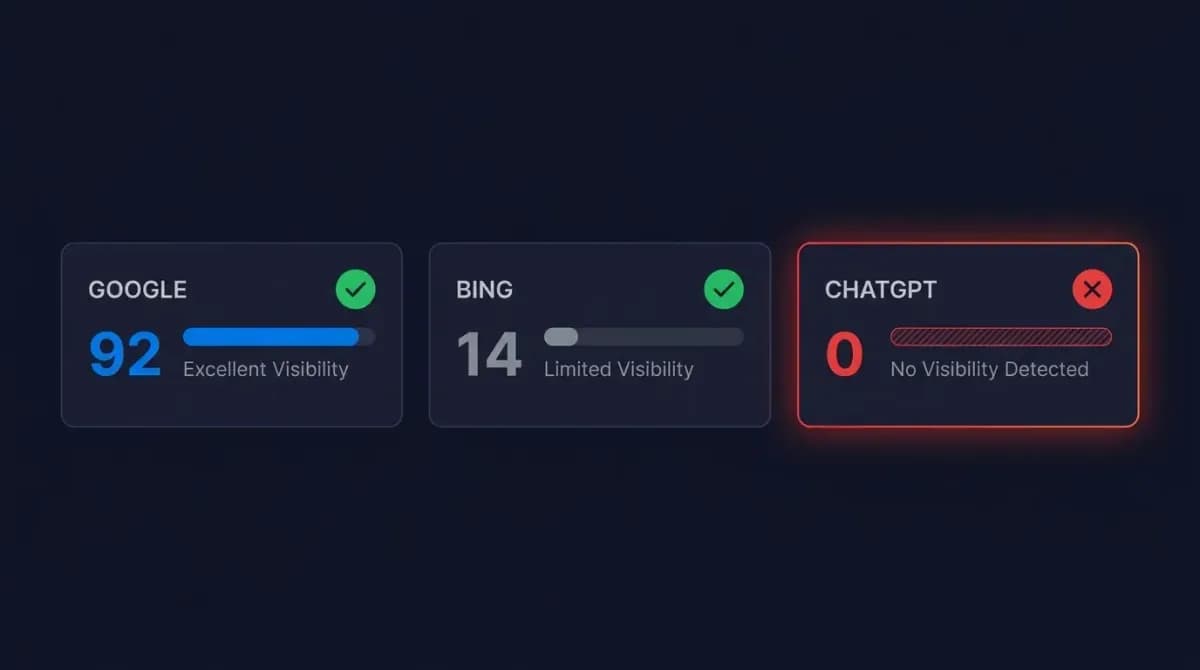
Your CEO asked ChatGPT about medical refrigeration solutions. Thermo Fisher came up. You didn't. For the flip side of that scenario, see our eight-year healthcare SEO case study — the brand that moved from invisible to sitting next to Thermo Fisher on hospital procurement shortlists.
You ranked on Google. You had good SEO. None of that mattered — because ChatGPT isn't reading Google. It's reading Bing. And you haven't looked at your Bing rankings since 2019. Neither has your agency.
That's the gap. And it's costing you pipeline right now — not in some theoretical future where AI search "becomes important," but today, while your buyers ask ChatGPT before they ever open a browser.
In brief: Answer engine optimization (AEO) is the practice of structuring content so AI platforms cite your brand. An AEO audit diagnoses why AI systems can't find or cite your content — across ChatGPT, Perplexity, Gemini, and 5 other platforms — and 87% of ChatGPT's brand recommendations follow Bing rankings, not Google's.
You're Not Losing Rankings. You're Not in the Conversation.
ChatGPT's top recommendation becomes the user's top pick 74% of the time. Not "influences." Becomes. The brands ChatGPT names get the meeting, the RFP, the shortlist. The brands it skips don't get evaluated — they get ignored.
And the volume is staggering. ChatGPT processes 2.5 billion queries per day with 81% of the AI search market. Google's own AI Mode — the feature Google built to compete — sees 93% of searches end without a click to any website. Traditional Google searches ending without a click have hit 80%. Add AI Overviews and it's 83%.
The rank→click→visit model that B2B marketing was built on? It's breaking. Buyers get the answer from the AI. If your brand isn't in that answer, there's nothing to click.
It's also getting harder, not easier. ChatGPT's latest model cites 20% fewer domains — 15.2 per response, down from 19.1. Fewer slots. More brands competing for them. The window is closing.
Your Bing Ranking Is Your ChatGPT Ranking
Eighty-seven percent of ChatGPT's brand recommendations align with Bing's top search results — not Google's.
Seer Interactive ran the same prompt 68 times and mapped the results against both Google and Bing rankings. Bing won. Decisively. You can dominate Google for your product category and still be invisible in ChatGPT if your Bing rankings are weak.
Most B2B companies haven't thought about Bing since it was a punchline. Most agencies don't track it. That indifference is now a strategic liability: competitors who happen to rank well on Bing are getting cited by ChatGPT, and they may not even know why.
The mechanism is simple. ChatGPT triggers what Seer calls "fanout queries" — 3 to 10 related searches against Bing's index. The brands that rank in Bing's results for those fanout queries are the brands ChatGPT cites. Google doesn't enter the equation.
Even your Google rankings are depreciating. AI Overviews cut organic CTR for position #1 by 58%. Only 1% of users click links inside an AI Overview. Being #1 on Google used to mean you got the click. Now it means you get shown in an answer that 99% of users scroll past.
For the full multi-platform optimization methodology, see Is AI Eating SEO? The B2B Guide to Answer Engine Optimization.
Three Gaps That Keep Your Brand Out of AI Answers
Most brands that are invisible in AI search share the same three gaps. An AEO audit — answer engine optimization audit — finds all three. It's a diagnostic of your brand's machine-readability: how well AI systems can find, understand, and cite your content. Not a tool score. A structural assessment.
A fourth, upstream gap often precedes these three: many B2B sites block the AI crawlers outright at the CDN or robots.txt level, and no amount of structured data fixes a bot that never reaches the page. GPTBot, ClaudeBot, PerplexityBot, and Google-Extended each need explicit allowances — and stale Cloudflare bot rules or a default Disallow: / line silently break the whole chain. The AEO guide's crawler-access checklist covers how to verify each crawler is getting 200 OK responses, not 403s or JavaScript challenges.
Structural gaps. AI systems extract information from structured data — JSON-LD schema markup — more readily than from unstructured prose. Pages with schema markup are 36% more likely to appear in AI-generated summaries, and structured pages earn 2.8x higher AI citation rates. An AEO audit checks whether your site has the structured data AI systems need: Organization schema, Article schema with author and dates, FAQ schema on question-answer content, and Service or Product schema on your offerings.
Platform-specific blind spots. Your brand may be visible on one AI platform and invisible on another. ChatGPT pulls from Bing. Perplexity uses its own web index. Google AI Overviews pull from Google's index. Claude relies primarily on training data. An audit checks each platform independently. A common finding: a brand ranks well on Google, has never submitted its sitemap to Bing, and is therefore invisible to ChatGPT and Microsoft Copilot simultaneously.
Content format gaps. AI systems prefer specific content formats when selecting what to cite. Self-contained summary blocks ("In brief" statements), definitive "X is Y" language, clean entity definitions on first mention, and FAQ sections structured as question-answer pairs all increase citation probability. Hedging language — "might be," "could be," "some experts think" — decreases it. An audit scans your content for these patterns and identifies pages where small formatting changes would make the content citable.
At Igility, we run AEO audits across 8 AI platforms simultaneously — ChatGPT, Perplexity, Gemini, Claude, Google AI Overviews, Microsoft Copilot, Grok, and Meta AI — because single-platform checks miss the blind spots. Our AEO methodology is built around this multi-platform approach.
Five Fixes You Can Ship This Week
None of these require a vendor, a budget, or a meeting. A few hours of work, measurable results.
1. Run a 30-minute manual audit. Open ChatGPT, Perplexity, Gemini, Claude, and Copilot. Ask each one: "What companies offer [your primary service] for [your industry]?" and "What is the best [your product category]?" Record which competitors appear and whether your brand is mentioned. This immediately reveals your visibility gaps across platforms.
2. Add "In brief" blocks to your top 5 pages. At the top of each key page — homepage, service pages, top blog posts — add a 2-3 sentence summary using definitive "X is Y" language. AI systems extract these as standalone answers. Example: "Answer engine optimization (AEO) is the practice of structuring content so AI platforms cite your brand in response to user queries. For B2B companies, effective AEO requires optimization across 8 distinct platforms simultaneously." This single change is the highest-ROI AEO tactic available.
3. Verify your site in Bing Webmaster Tools. Go to bing.com/webmasters, verify your domain, and submit your sitemap. If you've never done this, your site may not be fully indexed in Bing — which means ChatGPT can't find you. This takes 10 minutes and directly addresses the Bing→ChatGPT pipeline.
4. Add FAQ sections with schema markup to your highest-value content. Write 3-5 questions per page that match real search queries (check Google's "People Also Ask" for your keywords). Structure them as clean Q&A pairs. Implement FAQPage schema markup so AI systems can parse them directly. Pages with structured FAQ content are more likely to be cited in AI-generated answers.
5. Write clean entity definitions. Every product, service, methodology, and named concept on your site should have a standalone definition sentence on first mention. Not "We offer AEO services" — instead: "Answer engine optimization (AEO) is the practice of structuring content so AI platforms cite your brand in response to user queries. Igility's AEO methodology covers 8 AI platforms simultaneously." The second version is a citation-ready snippet that an AI system can extract verbatim.
All five work by making your existing content readable by AI systems. No new content required — you're restructuring what you already have.
DIY AEO Has a Ceiling
The five fixes above work. They'll improve your AI visibility for your highest-value pages, and you can do them this week. But they're the floor, not the ceiling.
Professional AEO methodology closes gaps that DIY can't reach:
- Your competitors are already investing. If brands like Thermo Fisher and Follett Healthcare are showing up in AI answers for your product category, they've built — deliberately or accidentally — the structured content and platform signals that AI systems reward. Catching up requires a systematic, multi-platform approach.
- You need Bing-specific optimization. Bing ranks differently from Google. It weights social signals more heavily. It prioritizes exact-match keywords in headings. It favors pages with multimedia content. A Google-only SEO strategy leaves the Bing→ChatGPT pipeline unaddressed.
- You need measurement infrastructure. Tracking AI visibility isn't like tracking Google rankings. You need to monitor brand citations across multiple platforms over time, track which content is being cited, and correlate Bing ranking movements with ChatGPT mention changes.
- Your structured data requirements are complex. Healthcare companies with HIPAA considerations, financial services firms, and companies with large product catalogs all have structured data needs that go beyond basic implementation.
- Off-site corroboration is the multiplier DIY rarely reaches. On-site optimization creates the conditions for citation; reviews on G2 or Clutch, analyst mentions, Wikipedia presence, and AggregateRating schema push probability from "possible" to "likely." AI systems triangulate — they don't trust any single source, including yours. A brand with strong on-site content plus G2 reviews plus a Wikipedia page plus earned press gets cited far more often than a brand with just a great website. The AEO guide's off-site corroboration layer walks through the industry-specific third-party platforms and the schema pattern that surfaces those external signals to crawlers indexing your own domain.
What to look for in an AEO partner: multi-platform methodology (not just ChatGPT), Bing optimization as a core practice, structured data expertise, off-site corroboration as a first-class workstream, and a measurement framework that tracks citations — not just rankings.
Your competitors may already be in the conversation. See where you stand across 8 AI platforms →
Frequently Asked Questions
What is an AEO audit?
An AEO audit is a diagnostic evaluation of how well AI systems — ChatGPT, Perplexity, Gemini, Claude, Google AI Overviews, and others — can find, understand, and cite your brand's content. It assesses structured data implementation, content format readiness, platform-specific visibility, and competitive positioning across AI answer engines. Unlike a traditional SEO audit that focuses on Google rankings, an AEO audit evaluates machine-readability across multiple AI platforms simultaneously.
What does AEO stand for?
In B2B marketing, AEO stands for Answer Engine Optimization — the discipline of structuring content so AI systems like ChatGPT, Perplexity, Gemini, and Microsoft Copilot cite your brand in their answers. Two unrelated meanings show up in the same SERP and confuse the question: Authorized Economic Operator is a customs compliance status under World Customs Organization frameworks, and AEO is also the NYSE ticker for American Eagle Outfitters. This article and the rest of Igility's AEO series cover the marketing discipline.
Why isn't my B2B brand showing up in AI answers even though we rank well on Google?
The structural reason: ChatGPT and Microsoft Copilot retrieve from Bing's index via fanout queries, not Google's. Seer Interactive's controlled study found 87% alignment between ChatGPT's brand recommendations and Bing's top results. Two practitioner thresholds correlate strongly with AI invisibility: fewer than ~15 high-authority off-site mentions (G2, Clutch, Wikipedia, analyst coverage, peer-reviewed citations) on domains with Domain Rating >60, and no FAQPage / Article schema for AI extractors to parse. Brands meeting both thresholds tend to disappear from category-query AI recommendations regardless of how their Google rankings look. The fixes are mostly mechanical — submit your sitemap to Bing Webmaster Tools, ship structured data, build off-site corroboration on the platforms your industry's buyers and AI systems both already trust.
How is AEO different from SEO?
SEO optimizes content for ranking positions in search engine results pages. AEO optimizes content for citation by AI systems that generate direct answers. SEO drives traffic through clicks on search results. AEO drives visibility through AI-generated responses that reference your brand. The two are complementary: strong Bing SEO directly supports ChatGPT visibility, since 87% of ChatGPT's brand recommendations align with Bing rankings. A complete digital strategy in 2026 requires both.
Is AEO replacing SEO?
No. AEO builds on SEO foundations. Google still drives substantial web traffic, and traditional rankings still matter. But the share of queries handled by AI systems is growing — 93% of searches in Google's AI Mode end without a click, and ChatGPT processes over 2.5 billion queries daily. AEO addresses the growing segment of buyer research that happens inside AI platforms rather than traditional search results. The investment for AEO is primarily structural: schema markup, Bing optimization, and content formatting changes that also improve traditional SEO.
How long does it take to appear in ChatGPT after implementing AEO changes?
Initial citation appearances typically occur within 30-90 days of implementing structured data, Bing verification, and citation-ready content. Perplexity tends to pick up new content fastest because it actively crawls the web. ChatGPT citations follow as Bing rankings improve. Compounding effects — where visibility in one platform reinforces authority in others — generally emerge at 3-6 months. The timeline depends on your starting authority, content volume, and competitive landscape.
Can I do an AEO audit myself?
You can run a basic audit in 30 minutes using the manual method described in this article — checking your brand's visibility across ChatGPT, Perplexity, Gemini, Claude, and Copilot. This reveals your most critical gaps immediately. For a comprehensive audit covering structured data analysis, Bing ranking assessment, content format scoring, and competitive benchmarking across all 8 AI platforms, Igility's AEO audit methodology provides the systematic coverage that a manual check can't match.
References
AI Search Behavior & Market Share
- Position Digital (2026). "100+ AI SEO Statistics for 2026." The AI's top pick becomes the user's top pick 74% of the time. 26% of AI Mode users override rank order due to brand recognition.
- Superlines (2026). "AI Search Statistics 2026: 60+ Data Points on Visibility, Citations, and Traffic." ChatGPT holds 81% AI search market share, drives 87.4% of AI referral traffic, processes 2.5B+ daily queries. GPT-5.3 Instant cites 20% fewer domains (15.2 avg, down from 19.1).
Zero-Click Search & AI Overviews
- Semrush (2025). "Google AI Mode and Zero-Click." 93% of AI Mode searches end without a click. Via Pillitteri, P. (2026).
- Click-Vision (2026). "50+ Zero Click Search Statistics for 2026." 80% of Google searches end without a click.
- Search Engine Land. "Google AI Overviews: Surge, Pullback, and What the Data Shows." AI Overviews appear on ~25-50% of tracked queries, with 83% zero-click rate when present.
- Ahrefs (2025). "AI Overviews reduce organic CTR for position 1 by up to 58%." Via Safari Digital (2026), "16 AI Overview (AIO) Statistics Worth Knowing in 2026."
- Pew Research (2025). "Only 1% of users click on links inside an AI Overview." Via ALM Corp (2026), "AI Overviews and Zero-Click Searches."
Bing & ChatGPT Brand Recommendations
- Nogami, M. & Tannenbaum, B. (2026). "Bing, not Google, shapes which brands ChatGPT recommends." Search Engine Land, April 6, 2026. Seer Interactive research: 87% of ChatGPT brand recommendations align with Bing's top results. Tested "What are the best hotels in New York City?" 68 times using GPT-5.2 Instant.
Structured Data & AI Citations
- xseek.io (2025). "How Does Structured Data Boost AI Search Visibility." 65% of pages cited in AI Overviews include structured data. Pages with schema markup are 36% more likely to appear in AI summaries. 2.8x higher citation rates for structured pages. Google and Microsoft (March 2025) confirmed use of schema markup during AI response generation.