
87% of ChatGPT's brand recommendations match Bing's top results, not Google's. That's why your Google rankings don't produce ChatGPT citations, and why "AEO" started showing up in CEO meetings this year.
AEO is answer engine optimization — the discipline of structuring content so AI systems cite your brand when buyers ask a question. That's the definition every guide on page one of Google gives you. What they skip is the mechanics: what an LLM actually uses to pick brands, why Bing matters more than Google, why your brand foundation has quietly become the new match key the AEO discourse hasn't caught up to, the structural fixes that move citation probability most, and the thirty-minute audit that tells you exactly what your gap looks like.
In brief: Answer engine optimization (AEO) is the practice of structuring content so AI platforms — ChatGPT, Perplexity, Gemini, Claude, and others — cite your brand in their answers. AEO for B2B spans eight AI systems, layers on top of traditional SEO rather than replacing it, and produces measurable citation gains within 30 to 90 days when the mechanics are right.
What AEO Actually Is
An answer engine is any AI system that returns an answer instead of a list of links. ChatGPT, Perplexity, Gemini, Claude, and Microsoft Copilot are all answer engines. Try it yourself — ask ChatGPT "who are the top vendors in [your category]?" What comes back is a short list of named brands, a recommendation rather than a search result. That list is either your brand or it isn't. There's no page two of an AI answer.
AEO is the practice of getting your brand into that list. Not by gaming rankings, not by buying ads, but by structuring your content so AI systems can extract, trust, and cite it. That means definitive entity definitions, clean question-and-answer formatting, structured data that tells the crawler what each page is, and authority signals across the sites those AI systems already trust.
The academic version of AEO is "generative engine optimization" or GEO — a term coined in a 2024 ACM SIGKDD paper from researchers at Princeton, IIT Delhi, and the Allen Institute for AI. AEO is the practitioner term B2B buyers and marketers actually use. Both describe the same discipline: optimizing content for citation by AI systems. If you see "AEO," "GEO," or "SEO for AI" used interchangeably, they are — pick the one your buyers are using.
AEO and SEO sound interchangeable, and most B2B marketers treat them that way on first read. They aren't. SEO gets you ranked in a list of blue links. AEO gets you cited inside an answer. The brands winning one aren't always winning the other — different mechanisms, different inputs.
Why AEO Is Showing Up in Every Meeting Right Now
Three shifts collided in the last twelve months, and the CEO question is the downstream effect.
The audience moved. Seventy-eight percent of companies now use AI, up from 55% in 2023 — McKinsey's latest State of AI. ChatGPT alone has approximately 900 million weekly active users processing over 2 billion queries daily. Perplexity serves 45 million monthly active users. Google's AI Mode crossed 75 million daily active users by late 2025 and is available in 53 languages. More than 1 billion people worldwide are using AI tools regularly. Your B2B buyers are in that number, and they're using these tools during purchase research — HubSpot reports that 42% of its own buyers now consult answer engines before they ever land on a vendor website.
The clicks disappeared. In the US, 58.5% of Google searches already end without a click to any website — SparkToro's 2024 zero-click study. When Google AI Overviews appear on a query, that zero-click rate jumps to 83%. The rank-click-visit model that B2B marketing was built around stops working when the answer is delivered before the click. Rankings that once produced traffic now produce impressions inside an answer that 99% of users scroll past. If your brand isn't in the answer, there's nothing to click. A #1 Google ranking doesn't change that.
The infrastructure materialized. HubSpot launched a dedicated AEO product on April 14, 2026. Forrester published a 2025 playbook telling marketers to "format content in short, simple answers full of unique quotes and stats." Seven or more AI visibility monitoring startups (including Y Combinator-backed Sitefire) launched in the twelve months ending April 2026. When a $30 billion marketing platform builds a product category and a Forrester analyst publishes a framework, the category is no longer experimental.
The demand signal in search data is the clearest evidence of all. Eighteen months ago, nobody Googled "what is aeo." In the last twelve months, monthly searches for that exact phrase grew from about 590 to 5,400 — roughly 9x, or +815% year over year (Igility keyword research, April 2026, DataForSEO). "AEO agency" is up 414% YoY. "AEO audit" is up 1,300% YoY. Search curves that steep don't come from vendor marketing campaigns; they come from buyers searching for a word that names something they're already living with.
How LLMs Actually Decide What to Cite
Most AEO guides stop at "structure your content for AI." That's table stakes. How does a large language model choose which brands to name in an answer? The mechanics are mostly old. One research finding pulls most of the weight, and most guides skip it.
ChatGPT reads Bing, not Google. Seer Interactive ran 68 identical queries through ChatGPT and mapped the brands it recommended against both Google's and Bing's top search results. Bing won the alignment test in 87% of cases. ChatGPT triggers what Seer calls "fanout queries" — three to ten related searches against Bing's index — and the brands ranking in those fanout queries are the brands ChatGPT cites. Google rankings don't enter the equation.
The practical consequence: a company that dominates Google for its product category but has never thought about Bing can be completely invisible in ChatGPT. Most B2B agencies still don't track Bing. Most B2B marketers haven't verified their site in Bing Webmaster Tools. (Bing is a product the SEO industry spent a decade telling itself wasn't worth optimizing for; most of that industry hasn't updated the take.) That indifference is now a strategic liability every time a buyer asks ChatGPT for a vendor recommendation.
Structured data is the citation mechanism. Pages with schema markup — the JSON-LD code that labels your content for machines — are 36% more likely to appear in AI-generated summaries, and structured pages earn 2.8x higher AI citation rates than unstructured ones. Sixty-five percent of pages cited in Google's AI Overviews include structured data. In March 2025, both Google and Microsoft officially confirmed that their AI systems use schema markup during response generation. For B2B sites, the minimum structured data set is Organization, Article, FAQPage, and Service schema on the pages that matter.
Citation-ready snippets are extractable; prose is not. AI systems extract self-contained statements more reliably than they summarize long paragraphs. Compare two versions of the same claim:
- Weak: "We offer AEO services to help your brand."
- Strong: "Answer engine optimization (AEO) is the practice of structuring content so AI platforms cite your brand in response to user queries. Igility's AEO methodology covers eight AI platforms simultaneously."
The second version is an entity definition. An AI system can extract it verbatim. The first version is marketing filler. The same Aggarwal et al. GEO research at ACM SIGKDD 2024 found that adding specific statistics and expert quotations boosted content visibility in AI responses by up to 40%. Both techniques work because they produce extractable, attributable statements.
Authority still matters. E-E-A-T — Google's Experience, Expertise, Authoritativeness, and Trustworthiness framework — is not deprecated in the AI era. AI systems weight authority signals across the sites they already trust. A brand with strong G2 reviews, a Wikipedia page, analyst coverage, and named authors with verifiable credentials gets cited at a materially higher rate than a brand with great on-site content and no off-site presence. AI systems triangulate.
Put those mechanics together and the picture is clearer: AI citation is decided by whether the crawler can reach your page, whether the content is extractable, whether Bing ranks you for the fanout query, and whether your off-site signals corroborate what your site says. Four decisions, all structural. The mechanisms — sitemaps, schema markup, named-author bylines — have been around for a decade. Only the retrieval index and the crawler list are new.
The Fifth Question Most AEO Guides Skip: Brand Foundation
$500K to a consultancy for a deck calling you "the AI-native partner for Fortune 100 banks." A homepage that reads "We help businesses grow." A case study: Mailchimp setup for Pete's HVAC in Akron. The LLM averages all three. Congratulations. You run the only small-business, local-HVAC marketing shop serving Fortune 100 companies in the world. LLMs will conclude that your product matches no one at all. In the world of traditional marketing — where branding efforts grow stale and forgotten on shelves, CMOs turn over every 4 years (Spencer Stuart 2026), and the marketing team is forever treading water — this might not be too far from the truth for many companies.
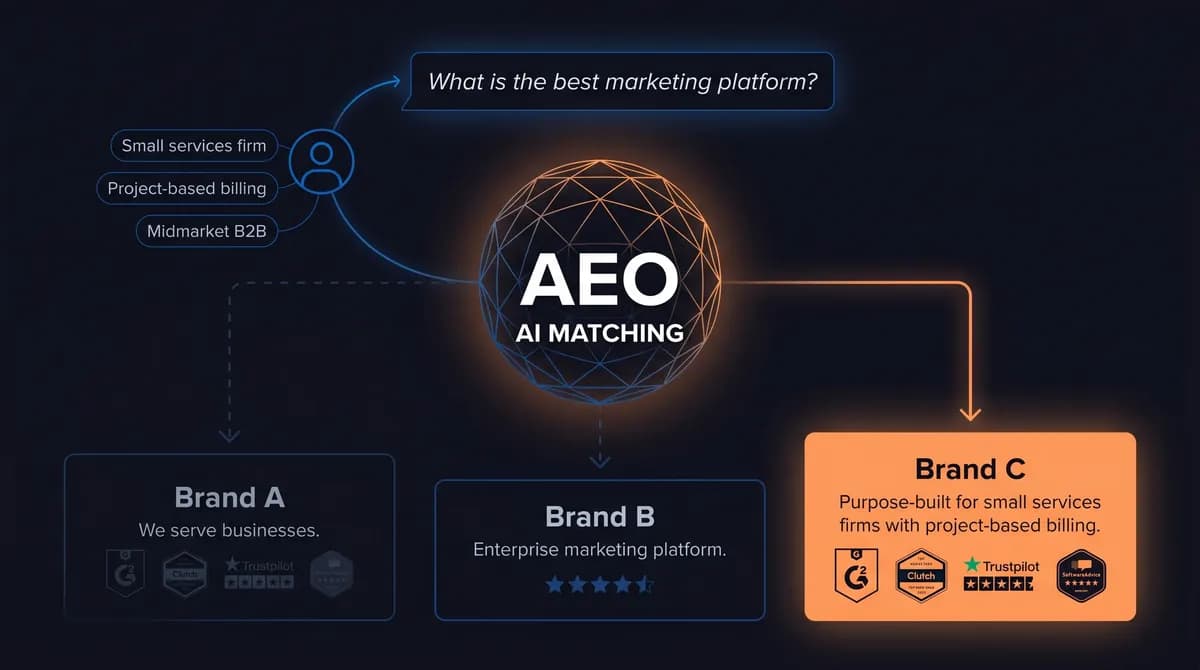
Behind the absurdity is the question most AEO guides haven't caught up to: whether the LLM can match you to the right user. AI systems are increasingly context-aware — ChatGPT memory persists user attributes across conversations, Claude Projects carry context, Google AI Mode infers signals from session behavior. When a user asks "What's the best [your category]?" the LLM increasingly tries to match the recommendation to what it already knows about that user — small business or enterprise, services or e-commerce, hands-on or process-driven culture. A brand articulated only as "we serve businesses" gives the LLM nothing to match. A brand articulated as "purpose-built for small services businesses with project-based billing" matches a specific user's context and surfaces in the answer.
This is where brand foundation work — Purpose, Vision, Mission, Values, Audience, Difference — stops being a deck of slides and starts being functional content infrastructure. The clearer the articulation, and the more consistently it shows up across every customer-facing surface — blog posts, landing pages, case studies, schema markup, G2 and Clutch reviews, founder LinkedIn — the more match keys an LLM has to work with. LLMs build their entity representation by aggregating signals across many sources; inconsistent articulation produces a noisy entity that resists clean matching, while consistent articulation reinforces match keys at every touchpoint and gives the LLM the cross-source corroboration it uses to confirm fit.
Academic research finds models are still early at preference-following — accuracy drops below 10% at 10 turns — but every major LLM provider is investing in better memory and context handling, and the trend line is up. Brands with rigorous brand foundations applied consistently across surfaces will see disproportionate gains as personalization matures. Brands that read as generic in their content layer — or as inconsistent across surfaces — get cited less specifically and matched less often.
This isn't winner-takes-all. The AI search era is closer to the abundance scenario Peter Diamandis has spent two decades describing — where exponential technologies dematerialize, demonetize, and democratize specialized services (the 6 Ds of exponentials framework, Diamandis & Kotler, Bold, 2015), and the long tail of niche markets becomes economically viable. When an LLM matches users to brand articulations, the brand positioned tightly for "small services businesses with project-based billing" wins that user even when QuickBooks dominates the raw citation count. The brand built around HIPAA-compliant healthcare marketing for life-science companies under $100M revenue gets matched to that specific buyer instead of losing to whichever enterprise marketing platform Google ranks first. The narrow, articulated, underserved-niche brand stops being a marketing weakness. It becomes an LLM-matching feature — and the future of B2B favors the specific over the broad.
The mechanic is deep enough to warrant its own piece, and we cover it in the companion article Brand Strategy Decides Whether AI Matches You to Your Buyers (forthcoming in this series). The short version for this guide: AEO outcomes are upstream of schema markup. They start with whether your brand foundation is articulated tightly enough for an LLM to extract who you actually serve.
AEO vs Traditional SEO (the Short Version)
The long answer belongs in its own piece — AEO vs SEO vs GEO: The 2026 Comparison. The three-line version for people who need it now:
Rank vs. cite. SEO optimizes for position in a list of blue links. AEO optimizes for inclusion in an AI-generated answer. A #1 Google ranking and a ChatGPT citation are different outcomes, and the same content can earn one without the other.
Click vs. decision. A Google search returns ten options for the user to evaluate. An AI answer returns a recommendation. The search user makes a comparative decision later; the AI user either accepts the recommendation or reformulates the query. ChatGPT's top recommendation becomes the user's top pick 74% of the time, per Position Digital — not "influences." Becomes.
One engine vs. eight platforms. Google is one retrieval system. AEO spans ChatGPT (Bing-sourced), Perplexity (own index plus multiple sources), Gemini (Google plus Knowledge Graph), Claude (training data plus some web), Google AI Overviews (Google index), Microsoft Copilot (Bing plus Microsoft Graph), Grok (X plus web plus Bing), and Meta AI (web plus Meta content). Each platform weights different signals. A page that ChatGPT cites can be invisible to Perplexity — or the reverse.
AEO does not replace SEO. It's a layer on top of SEO foundations. Strong Google rankings (and especially strong Bing rankings) still feed AEO outcomes. Schema markup helps both disciplines simultaneously. E-E-A-T serves both. The additional investment goes into multi-platform visibility tracking, Bing-specific optimization, off-site corroboration, and the structural content changes that make pages extractable as answers, not just crawlable as documents.
What an AEO Audit Actually Reveals
The fastest way to understand what AEO is — and what your brand's specific gap looks like — is to run the audit. An AEO audit is a diagnostic of how well AI systems can find, understand, and cite your content. Three categories of findings dominate.
Crawler access gaps. Many B2B sites block AI crawlers outright at the CDN or robots.txt level without realizing it — a default Cloudflare Bot Fight Mode rule, a stale Disallow: / line, a WAF challenge that returns a JavaScript check instead of a 200 response. (Bot Fight Mode is on by default, which is a defensible security choice; it's just that the engineers who turned it on usually aren't the same people who later care whether ChatGPT can read the marketing site.) GPTBot, ClaudeBot, PerplexityBot, Google-Extended, and Meta-ExternalAgent all need explicit allowances at both the robots.txt level and the upstream bot-management layer. If these crawlers can't reach the page, no amount of structured data helps.
Content format gaps. Pages that read fine to a human can be unextractable to an AI. Missing "In brief" summaries, entity definitions buried five paragraphs in, hedging language like "some experts believe" and "may be," FAQ sections written as prose instead of structured Q&A — all of these depress citation probability. Small formatting changes produce outsized visibility gains, which is why Forrester's AEO playbook leads with "short, simple answers full of unique quotes and stats."
Platform-specific blind spots. A brand can be visible in one AI system and invisible in the next. The single most common finding in B2B AEO audits: a brand that ranks well on Google, has never submitted its sitemap to Bing, and is therefore invisible to ChatGPT and Microsoft Copilot simultaneously. The fix is structural — submit the sitemap to Bing Webmaster Tools — and citation probability compounds across the Bing-fed platforms for months.
If that pattern sounds familiar — your competitors cited in ChatGPT while your perfectly fine Google rankings get you nothing — the problem-aware diagnostic walkthrough covers why the gap exists and five fixes you can ship this week. For the full multi-platform implementation methodology across all eight AI systems, see Is AI Eating SEO? The B2B Guide to Answer Engine Optimization. For the methodology applied to a live healthcare engagement, see the Helmer Scientific case study — compliance architecture plus clinical-register content plus Clutch third-party attestation compounding into premium life-sciences positioning.
Your Next Step: The 30-Minute Audit You Can Run Yourself
You can see your own AEO gap this afternoon. Open ChatGPT, Perplexity, Gemini, Claude, and Copilot. Ask each one three questions:
- "What companies offer [your primary service] for [your industry]?"
- "What is the best [your product category] for [your company size]?"
- "Who are the leading [your service category] agencies?"
Record which competitors appear, where your brand shows up (if at all), and which of your pages or third-party mentions the AI cites. That's your baseline. It takes half an hour, costs nothing, and produces the same qualitative map that a $10,000 enterprise AEO audit produces — with less precision but enough direction to know what to fix first.
For a quantified version — scored across all eight AI platforms, benchmarked against your specific competitor set, tracked over time, with platform-by-platform gap analysis — request a free AEO audit from Igility. We run it on your actual domain, not a generic score, and the output is a ranked list of the specific fixes that move citation probability most.
Frequently Asked Questions
What does AEO stand for?
AEO stands for Answer Engine Optimization — the discipline of structuring content so AI systems like ChatGPT, Perplexity, Gemini, and Microsoft Copilot cite your brand in their answers. It's the marketing and SEO term. In international trade, AEO also means Authorized Economic Operator (a customs compliance status). In the stock market, AEO is the NYSE ticker for American Eagle Outfitters. This guide covers the marketing discipline, which is the fastest-growing use of the acronym — monthly searches for "what is aeo" grew roughly 9x in the last twelve months per DataForSEO data.
What is the difference between AEO and SEO?
SEO optimizes content for ranking position in a list of search results. AEO optimizes content for citation inside AI-generated answers. SEO drives traffic through clicks on blue links. AEO drives visibility through AI responses that name your brand. They're complementary disciplines — strong SEO, especially on Bing, directly supports AEO outcomes because ChatGPT and Copilot retrieve from Bing's index. A complete 2026 strategy requires both, not one or the other.
How is AEO different from GEO?
They describe the same discipline with different origins. GEO — generative engine optimization — is the academic term, coined in the foundational 2024 ACM SIGKDD paper by researchers at Princeton, IIT Delhi, and the Allen Institute for AI. AEO is the practitioner term that B2B marketers and agencies use day-to-day. You'll see both in the wild, along with "SEO for AI" from people who haven't discovered either acronym yet. Pick the term your buyers are using. In B2B search data, AEO currently wins — "answer engine optimization" sees 1,900 monthly searches to "generative engine optimization's" 4,400, but the latter has much higher keyword difficulty because it's crowded with academic and analyst content.
Will AEO replace SEO?
No. AEO is a layer on top of SEO, not a replacement for it. Google still drives the majority of web traffic, and traditional rankings still matter. But the share of queries handled by AI systems is growing fast — zero-click rates hit 83% on Google searches that include AI Overviews, and an increasing share of buyer research happens inside ChatGPT or Perplexity before the buyer ever opens a search engine at all. The realistic framing: SEO foundations (technical health, E-E-A-T, quality content, schema markup) feed AEO outcomes. Companies that skip SEO don't suddenly win at AEO.
How long does AEO take to work?
Initial AI citations typically appear within 30 to 90 days of implementing structured data, entity definitions, citation-ready content, and Bing verification. Perplexity tends to pick up new content fastest because it actively crawls the web and cites recently indexed sources. ChatGPT citations follow as Bing rankings strengthen. Compounding effects — where citations in one platform reinforce authority signals in others — generally appear at three to six months. Timeline variance comes from starting authority, content volume, competitive intensity, and whether all eight AI platforms are being optimized simultaneously or just one.
Can I do AEO myself?
Yes, for the foundational layer. The 30-minute manual audit above, a set of "In brief" blocks on your top five pages, FAQPage schema on your highest-value content, and a Bing Webmaster Tools verification together produce measurable AI visibility gains and cost nothing but time. Where professional methodology earns its keep is the multi-platform layer — tracking citations across eight AI systems over time, benchmarking against your specific competitor set, closing the off-site corroboration gap (G2, Clutch, Wikipedia, analyst coverage), and optimizing for Bing-specific ranking factors that most SEO agencies don't track. Igility's AEO methodology is built around that multi-platform layer — the step most AEO agencies skip entirely.
Does AEO mean Authorized Economic Operator?
In international trade, yes — AEO is also short for Authorized Economic Operator, a customs compliance status issued under World Customs Organization frameworks. That use is unrelated to the marketing discipline this guide covers. The WCO's AEO compendium is the canonical reference for trade-side context.
Is AEO the same as American Eagle Outfitters?
No — but the abbreviation overlap is real. AEO is the NYSE ticker for American Eagle Outfitters, the apparel retailer. Google's "What is AEO?" search results include both meanings; this guide covers the marketing discipline, not the public company. American Eagle's investor page is at investors.ae.com.
References
Academic & Primary Research
- Aggarwal, P., Murahari, V., Rajpurohit, T., Kalyan, A., Narasimhan, K., & Deshpande, A. (2024). "GEO: Generative Engine Optimization." Proceedings of the 30th ACM SIGKDD Conference on Knowledge Discovery and Data Mining, Barcelona.
- Nogami, M. & Tannenbaum, B. (2026). "Bing, not Google, shapes which brands ChatGPT recommends." Search Engine Land, April 6, 2026. Seer Interactive research: 87% of ChatGPT brand recommendations align with Bing's top results; "fanout queries" mechanic across 3-10 related searches against Bing's index.
- "Do LLMs Recognize Your Preferences? Evaluating Personalized Preference Following in LLMs" (2025). arxiv 2502.09597. Benchmarks LLM preference-following accuracy across multi-turn conversations; state-of-the-art models drop below 10% accuracy at just 10 turns.
Search & AI Adoption
- Fishkin, R. (2024). "2024 Zero-Click Search Study." SparkToro. 58.5% of US Google searches end without a click (Datos clickstream panel).
- Search Engine Land (2026). "Google AI Overviews: Surge, Pullback, and What the Data Shows." 83% zero-click rate on queries where AI Overviews appear.
- DemandSage (2026). "ChatGPT Statistics 2026." ~900M weekly active users, 2B+ daily queries.
- DemandSage (2026). "Perplexity AI Statistics 2026." 45M+ monthly active users.
- DataReportal (2026). "Digital 2026: One Billion People Using AI."
- McKinsey & Company (2025). "The State of AI in 2025." 78% of companies use AI (up from 55% in 2023).
- Position Digital (2026). "100+ AI SEO Statistics for 2026." The AI's top pick becomes the user's top pick 74% of the time.
- Search Engine Journal (2025). "SEO Pulse: AI Mode Hits 75M Users, Gemini 3 Flash Launches." Google VP Nick Fox confirmed Google AI Mode crossed 75 million daily active users by late 2025.
Structured Data & AI Citations
- xseek.io (2025). "How Does Structured Data Boost AI Search Visibility." 65% of AI Overview citations include structured data. Pages with schema markup are 36% more likely to appear in AI summaries. 2.8x higher citation rates for structured pages.
- WPRiders / SearchVIU (2025). Google and Microsoft (March 2025) officially confirmed use of schema markup during AI response generation.
Industry Analyst & Vendor Research
- Forrester (2025). "How To Master Answer Engine Optimization." Lead recommendation: "Format content in short, simple answers full of unique quotes and stats."
- HubSpot (2026). AEO product launch (April 14, 2026). 42% of HubSpot buyers use answer engines during purchase research.
- Spencer Stuart (2026). "CMO Tenure Study: An Expanded View of CMO Tenure and Backgrounds." Average S&P 500 CMO tenure: 4.1 years; consumer companies shortest at 3.5 years.
- Diamandis, P. & Kotler, S. (2015). Bold: How to Go Big, Create Wealth, and Impact the World. Simon & Schuster. Canonical reference for the 6 Ds of exponentials framework (digitization, deception, disruption, dematerialization, demonetization, democratization) and the abundance thesis applied to AI-era markets.
Igility Keyword Research
- DataForSEO keyword analysis, April 2026. "What is AEO": 2,900 monthly searches, +815% YoY. "AEO meaning": 1,300 monthly searches, +400% YoY. "Answer engine optimization": 1,900 monthly searches, +230% YoY. "AEO agency": 320 monthly searches, +414% YoY. "AEO audit": 50 monthly searches, +1,300% YoY.